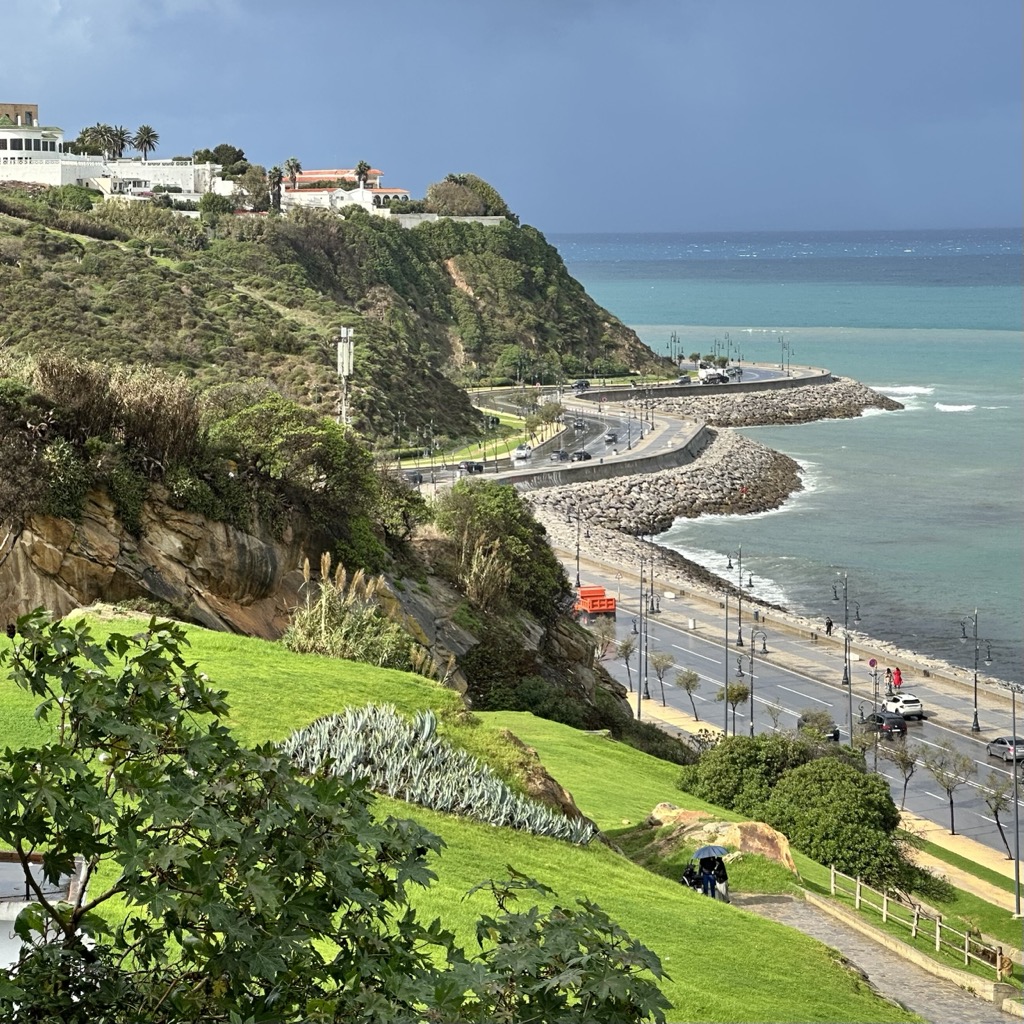
Tangier
Where Continents Meet, Legends Whisper – A Tangier Journey Through Spies, Saints, and Strait Views
Step into Tangier, the mythical Moroccan city that has lured rebels, writers, and rogues for centuries. This immersive walking tour unravels the layers of a place where Africa nearly touches Europe, and where every alley holds a secret.
Begin at Grand Socco, the vibrant gateway where the old medina collides with modern Tangier. Here, your guide brings to life the 1947 speech by King Mohammed V that helped ignite Morocco’s independence movement – a pivotal moment in colonial history. Stroll into the labyrinth to Petit Socco, the legendary café square where Paul Bowles, William Burroughs, and the Beat Generation traded stories and spies over mint tea. Feel the ghostly charm of Ottoman-era trading and literary gossip.
Next, uncover a truly unique landmark: the American Legation Museum, the only U.S. National Historic Landmark on foreign soil. Inside a rambling 19th-century palace, discover how Morocco became the first country to recognize American independence in 1777. Admire Delacroix-inspired art, the Paul Bowles archive, and rooms that whisper centuries of diplomacy and bohemian intrigue.
Climb to the Kasbah of Tangier – a fortress above the Strait with Phoenician, Roman, Marinid, and Portuguese echoes. From Sultan Moulay Ismail’s legacy to English occupation, the stones tell of dynasties rising and falling. Pause at the Kasbah Sea Viewpoint, where you can literally see two continents at once: Africa beneath your feet and Europe across the shimmering water. Here, we reflect on the Strait’s epic role – from Hercules and pirates to modern migration and NATO patrols.
No Tangier pilgrimage is complete without Café Hafa, a cliffside terraced icon since 1921. Sip mint tea where the Rolling Stones once lounged, gazing over the Atlantic towards Spain. Finally, venture to Cape Spartel and the legendary Caves of Hercules – a mythic sea cave shaped like the African continent. Hear the legend of Hercules resting here after his labors, while waves crash against millennia-old rock. (Perfect photo moment included.)
This tour blends history, art, geopolitics, and pure magic – all in under four hours. Whether you’re a literary pilgrim, history buff, or simply a curious traveler, Tangier will leave its mark on you.
Route Overview
Stops on this Tour (7)
Grand Socco
You are standing in what might be the single most important square in Tangier. Grand Socco is the hinge, the breathing space between the ancient medina that rises behind you and the colonial boulevards that stretch ahead. Lift your eyes and take a slow look around. To one side, the medina gate opens into centuries of winding lanes. To the other, wide streets cut through with French-built facades. The air here carries something specific: the smell of cumin and diesel, roasting nuts and orange blossom, all of it layered together in a way that feels uniquely like Tangier. This square has been the place where worlds collide for well over a hundred years, and it still earns that description today.
Petit Socco
Step into this small square and let your eyes adjust to it. Petit Socco is not large, and that is the point. It is a tight, irregular oval of low buildings and café terraces, with just enough room for a few dozen people to linger, argue, fall in love, and exchange secrets. The tiles beneath your feet and the faded paint on the shuttered windows above speak of a place that has seen extraordinary things and has decided not to shout about them. For more than a century, this modest square was the nerve center of one of the most unusual cities in the world. Travelers, merchants, writers, spies, con men, and dreamers all passed through here, and many of them never quite left.
American Legation Museum
You are standing at number 8 Zankat America, America Street, inside the medina of Tangier. Look up at the whitewashed facade rising above you, the wooden screens, the carved archways. Take a moment and let that name sink in, because this building has been American soil, in a legal and diplomatic sense, for over two hundred years. The Tangier American Legation is the only U.S. National Historic Landmark on foreign territory, anywhere in the world. Not in London, not in Paris, not anywhere. Here, in this medina, on this narrow lane. What you are looking at right now is the oldest piece of American public property outside the United States, gifted to the young republic by the Moroccan sultan in 1821. And the story of why it exists here at all begins not in Washington, but in a proclamation issued forty-four years before that, when Morocco became the first country on earth to recognize American independence.
Kasbah of Tangier
Feel the incline under your feet and look out toward the water. You have just climbed to the highest point of the old city, and what is in front of you is not a view so much as an argument. Two seas press against each other out there , the Atlantic coming from the west, the Mediterranean exhaling from the east , and for more than two thousand years, every empire that wanted to control that argument believed it had to control this hill first. Welcome to the Kasbah of Tangier. The walls around you have belonged to Phoenicians, Romans, medieval Moroccan sultans, Portuguese governors, English soldiers, and the Alaouite dynasty. Most places collect history quietly. This one accumulates it like sediment, layer on visible layer, right up through the stones beneath your shoes.
Kasbah Sea Viewpoint
Take a breath. Feel the wind coming off the water. What you are standing on right now is the highest point of the old Kasbah terrace, and there, right in front of you, is the Strait of Gibraltar. Two continents, one glance. On a clear morning like this, the coast of Spain is sharp and close enough that you could almost mistake it for the far bank of a wide river. It is, in fact, just fourteen kilometers away at the narrowest point. That low hill you can see across the water is not a cloud on the horizon. It is Europe. And you are standing in Africa. Take a moment to let that settle, because very few places on earth give you this particular sensation.
Café Hafa
You have walked out to the edge of Africa. Behind you, the Marshan neighborhood spills back toward the medina. In front of you, the terraces of Café Hafa drop away in layers down the clifftop, and beyond them, open water. On a clear afternoon, the whitewashed buildings of Tarifa in southern Spain are visible across the strait, close enough to seem like a dream you could swim toward. This is the view that has pulled people here since 1921, and it has not changed.
Cape Spartel and Caves of Hercules
You are standing at the edge of the ancient world. Right here, at Cape Spartel, the Atlantic Ocean and the Mediterranean Sea press against each other in a slow, churning collision that sailors have watched with a mixture of awe and dread for thousands of years. Look out toward the water. That pale haze on the horizon where the blue changes texture, that is the boundary between two seas, and this cape is the hinge point where Africa swings out to meet it. For the Phoenicians, for the Romans, for every navigator who ever rounded this headland, this was the last familiar landmark before the open ocean swallowed everything. You are not just at a scenic overlook. You are at one of the great turning points of the ancient world.
Start this Journey
Download the Morocco Audio Tours Offline app to unlock the full audio guide, offline maps, and GPS navigation for this tour.