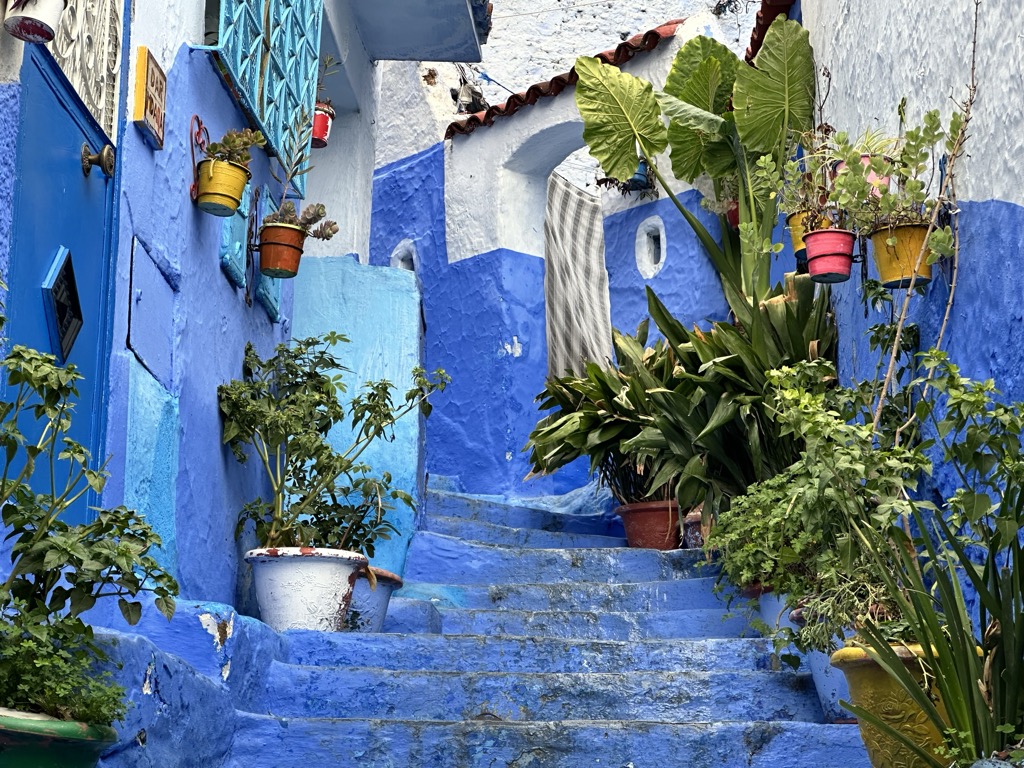
Explore the enchanting blue streets of Chefchaouen on foot. This walking tour guides you through the medina’s winding alleys, vibrant markets, and tranquil viewpoints, offering a perfect blend of culture, history, and breathtaking scenery.
Route Overview
Stops on this Tour (7)
Bab El Ain Gate
This is where the city formally begins. The arch rising in front of you is Bab El Ain, the Gate of the Spring, and the name is not decorative. It is a direct acknowledgment of the water source above, the spring that made this settlement possible in the first place. The gate sits at the southern entrance to the medina, flanked by sections of the original town wall, and if you look at the stonework around the arch, you will notice it is rougher and more weathered than almost anything else you will see today. That roughness is age. You are standing at what has been the main arrival point into Chefchaouen since the city was founded in 1471, and the people who built this gate were refugees from Andalusia who had crossed the sea with almost nothing and were starting over on a hillside in the Rif Mountains.
Souk and Artisan Shops
You have just come through Bab El Ain, one of the old entry points that once controlled who passed in and out of this city, and already the medina has closed around you in that particular way it has, gradually at first, then all at once. The gate's threshold is barely behind you and the air has already changed, thicker now with cedar shavings and dried herbs, the light narrowed between the walls, the sound of footsteps on uneven stone replacing whatever quiet you had at the gate. This is the souk, the commercial heart of Chefchaouen, and it has been exactly this, a place of exchange, craft, and daily negotiation, since the city's fortress and first settlement were established around 1471, with the medina taking fuller shape by 1480. The lanes here are not wide. Stalls press close on both sides. The souk is not a tourist construction. It was trading in wool, leather, and mountain herbs long before most visitors had heard of this city, and that history is still visible if you know where to look.
Grand Mosque (Jamaa El Kebir)
After the sensory bustle of the souk — the dyed wools, the cedar smell, the vendors calling across narrow lanes — stepping into Plaza Uta el-Hammam feels like the city exhaling. And there, at the western edge of the square, is the Grand Mosque, Jamaa El Kebir in Arabic, rising with a quiet authority that has nothing to do with size. Its whitewashed facade faces the open plaza, and the octagonal minaret above it catches the afternoon light in a way that makes it look almost luminous against the blue hills behind. The square itself is alive around you, children cutting across the tiles, men at the cafe tables along the Kasbah wall, pigeons moving in slow arcs overhead. This has been the center of Chefchaouen since the city's earliest decades, and the mosque has stood at the middle of it all for centuries.
Plaza Uta el-Hammam
You have just come from the Grand Mosque, one of the spiritual anchors of Chefchaouen, and now you are standing in its civic counterpart — Plaza Uta el-Hammam, the beating heart of the city. The name translates roughly as the Place of the Bathhouse, a nod to the old hammam that once anchored daily life on this very ground. Step into the square and let your eyes adjust: terracotta café chairs spill across the uneven paving stones, the smell of mint tea and charcoal drifts from the kitchen windows above, and the ochre walls of the old kasbah rise on your left like a sun-warmed cliff. Where the mosque gave you quiet and devotion, this plaza gives you noise and life — vendors, children, old men nursing glasses of tea, and the low hum of a city going about its business. This is not a square that was designed for tourists. It grew slowly, organically, shaped by the people who washed here, prayed here, argued here, and sold their vegetables here for centuries. Everything in Chefchaouen eventually leads back to this plaza.
Kasbah Museum
You have just come from the open, social heart of the city in Plaza Uta el-Hammam, and now notice how the atmosphere shifts the moment you step inside these walls. The noise of the square softens, the air cools, and the stone around you feels entirely different from the smooth blue plaster of the lanes. Run your hand along the wall. Rough, gritty, warm. This is Rif stone, the same material that forms the ridgelines you can see above the rooftops, and it has been standing here since Moulay Ali ibn Rashid founded Chefchaouen in the fifteenth century. The kasbah was the military and administrative heart of the city before the plaza outside it even existed. The decisions made within this enclosure, about who could settle here, how the community would govern itself, how it would defend itself, are what allowed everything you have been walking through today to survive and take shape. In a real sense, the blue medina you have been exploring grew outward from this single, quiet enclosure.
Ras El Maa Waterfall
The Kasbah Museum gave you the political story, the walls, the garrison logic, the careful record of who built what and why. Now the medina offers you something older and less official. As you climbed northeast from the kasbah and the lanes narrowed to shoulder width around you, you may have noticed the air shifting, a coolness threading through the warmth, a faint mineral freshness that does not belong to the painted plaster or the cedar woodsmoke drifting from a doorway. That is the water announcing itself. Ras El Maa, which translates simply as the head of the water, or the water source, is exactly what its name promises. This is where the spring emerges from the Rif Mountains and drops into the city in a small but persistent cascade, feeding the channel that has run through this medina since before the first stone of the kasbah was ever laid. The flat slabs beside the stream, the women who still come here to wash laundry in the cold current, the cats that arrange themselves along the bank with practiced patience, all of it feels less like a tourist sight and more like a working part of the city that simply forgot to hide itself.
Spanish Mosque
That climb from Ras El Maa, past the sound of the stream fading below and the blue rooftops slowly spreading out beneath your feet, is one of those walks that changes the way you see a place. You have been inside the medina, moving through its narrow lanes at street level, where the blue walls press close and the sky appears only in narrow strips above. Now, standing up here on this open hillside, the whole city reveals itself at once. The Spanish Mosque sits just ahead of you, a low, square-shouldered building in pale stone, quieter and more austere than anything you have seen in the medina below. It does not announce itself the way a grand minaret does. It simply waits, perched on the ridge, with the entire Rif Mountain range fanning out behind it and Chefchaouen laid out below like a painted map.
Start this Journey
Download the Morocco Audio Tours Offline app to unlock the full audio guide, offline maps, and GPS navigation for this tour.