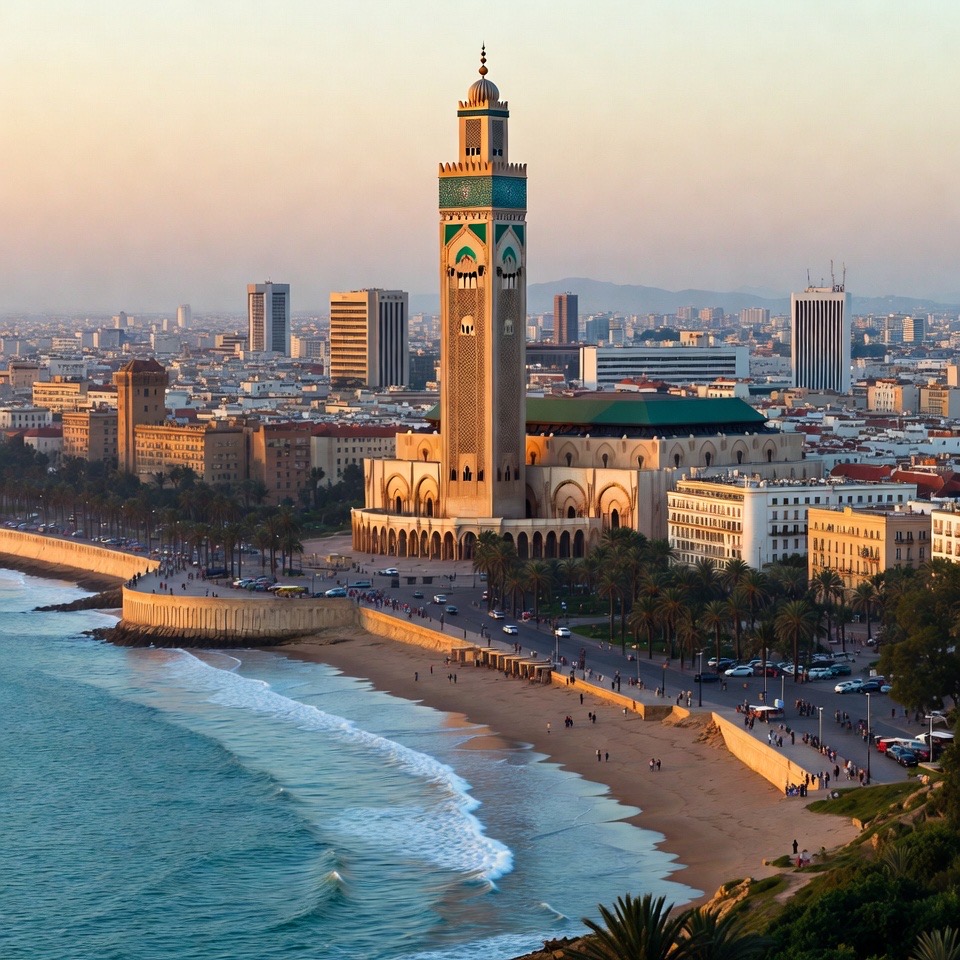
Forget everything you think you know about Casablanca. This isnt just a stopover; its a city of bold architectural ambition, authentic urban rhythm, and stunning coastal drama. This 5-kilometer walking tour is your key to unlocking the real Casablanca, weaving from its serene colonial heart through vibrant souks to the majestic Atlantic edge.
Your journey begins in tranquility at the Cathedral of the Sacred Heart, a deconsecrated Neo-Gothic masterpiece bathed in the soft morning light of the adjacent Parc de la Ligue Arabe. As the city awakens, well walk to Mohammed V Square, the citys civic stage. Here, the newly inaugurated Grand Théâtre de Casablanca (CasArts) , a luminous vision by Christian de Portzamparc, engages in a stunning architectural dialogue with the 1920s Neo-Moorish grandeur of the Palace of Justice. This is a perfect introduction to Casas layered identity.
Continuing along the bustling Boulevard Mohammed V, well trace an open-air museum of geometric Art Deco and Neo-Moorish facades. This architectural corridor leads us to the vibrant chaos of Place des Nations Unies, the citys historic hinge, before arriving at the sensory feast of the Marché Central. Here, beneath a steel-and-glass canopy, youll find pyramids of spices, glistening Atlantic fish, and the energy of local life. Its a perfect spot to pause and absorb the atmosphere before we delve deeper.
Leaving the modern boulevards behind, we pass through the ancient arch of Bab Marrakech and into the labyrinthine soul of the city: the Old Medina. Unlike the tourist-focused medinas of Marrakech or Fes, this is an authentic, working quarter where the air is thick with the scent of grilled sardines and orange blossom. Let the flow of locals guide you past copper workshops and textile stalls, where you can haggle for traditional babouches or handwoven blankets.
Emerging from the maze, youll feel the cool Atlantic breeze as we reach the 18th century Sqala du Port. This historic fortress offers a breathtaking panorama of the fishing harbor and crashing waves. It is a dramatic contrast to the medinas intimacy. Just steps away, well glimpse the iconic facade of Ricks Café, a loving homage to the classic film, before our grand finale.
The towering minaret of the Hassan II Mosque now dominates the skyline, drawing us along the coastal road. One of the largest mosques in the world, its location seems to defy the sea itself. Here, non-Muslim visitors are welcome on guided tours to witness its breathtaking craftsmanship, from intricate zellij tilework to its retractable roof, all while the Atlantic sprays against its base.
This is Casablanca: a city of bold contrasts, authentic encounters, and unforgettable sights. Lace up your walking shoes and lets discover it together.
Tour Details:
- Distance: Approx. 5-6 km
- Pace: 4-5 hours (relaxed)
- Lunch Options: Marché Central food stalls or the restaurant at Sqala du Port.
- Shortcut Option: A petit taxi from Bab Marrakech to Sqala du Port can bypass the medina if needed.
- Note on the Mosque: Non-Muslim tours are not offered Friday mornings. Book tickets in advance via the official Foundation for the Hassan II Mosque. Modest dress (covered shoulders and knees) is required.
Route Overview
Stops on this Tour (8)
Cathedral of the Sacred Heart & Parc de la Ligue Arabe
Welcome to Casablanca. You're standing before the Cathedral of the Sacred Heart, a building of white stone that seems to hold the city's past in its very architecture. Notice the twin towers framing the Atlantic sky, the ornate details around the main portal, and the way the structure sits at the edge of Parc de la Ligue Arabe, a green oasis amid the urban hum. This place has a quiet secret: despite its name, it was never actually a cathedral in the official sense—no bishop ever presided here. It was built as a parish church for a colonial community, and that gap between name and reality makes it a perfect starting point for understanding Casablanca.
Mohammed V Square & Grand Théâtre de Casablanca
Mohammed V Square has been remade, renamed, and argued over continuously—a civic center defined not by stillness but by transformation. Since 1916, this rectangle has carried at least six official names, from Grande Place to Place de France to its current name, each a register of who governed and what story the city told about itself. The square’s perimeter is now completed by the Grand Théâtre’s sweeping curves, an architectural answer to the colonial-era buildings that still flank the other sides, while pigeons claim the central fountain as their own through every change of regime.
Place des Nations Unies
Place des Nations Unies is where the medina wall, the port axis, and the ville nouvelle grid meet. The fountain at the center isn't original—the square has been reshaped by the politics of each era. What remains constant is its role as the city's meeting spot: where taxi drivers wait, commuters cross, and schoolchildren cut through without ever glancing up at the surrounding architecture.
Boulevard Mohammed V Art Deco Corridor
Welcome to Boulevard Mohammed V, one of the best places in Casablanca to understand the city by simply looking up. Stand for a moment and let the street assemble itself around you: arcades, balconies, tramlines, shop signs, old facades, and the constant movement of people getting somewhere. This boulevard is not just a road through the center. It is a long architectural argument about what Casablanca wanted to become in the twentieth century. The buildings around you mix Art Deco geometry with Moroccan craft details, so the street feels modern and local at the same time. That tension is the real subject of this stop.
Marché Central
Welcome to Marché Central, Casablanca's central market, and one of the quickest ways to feel the city shift from architecture into appetite. The boulevard outside is wide, planned, and public, but here the scale changes immediately. Voices bounce under the covered walkways, fish lie on crushed ice, flowers brighten the entrances, and the air carries salt, herbs, citrus, and frying oil. This is not a market built mainly for photographs. It is a working place where the city buys, sells, eats, negotiates, and pauses. If Boulevard Mohammed V is Casablanca's designed face, Marché Central is one of its living interiors.
Bab Marrakech & Old Medina Entrance
Bab Marrakech's sandstone archway stands warm from the sun, its surface rougher under your fingers than it appears from across the square. This gate predates the French bombardment of 1907 and the urban plans that later carved the ville nouvelle from the medina. For centuries, it has marked the natural entry point from the inland road to Marrakech into a walled city that operated on its own terms long before anyone drew a distinction between old and new.
Old Medina Souks
The Old Medina Souks announce themselves first through scent — the warm yeast of sfenj frying nearby, sharp cumin ground fresh, and the deep leather from workshops tucked into side alleys. This market has operated here since Casablanca had a commercial district, long before the boulevards outside were drawn. Movement flows around handcarts and motorcycles in passages barely three meters wide, an improvised order learned through daily repetition.
Sqala du Port & Rick's Café
The air here carries a distinct Atlantic chill, even on warm days, as salt spray drifts up from the fishing boats moored below the old Portuguese ramparts. This sqala, a fortified bastion built in the 18th century, once protected the harbor with rows of cannons pointed seaward. Today, those same cannons overlook a different kind of landmark: the iconic blue doorway of Rick's Café, a deliberate recreation of the fictional bar from the film that never actually existed in Casablanca. This corner of the waterfront holds both the city's tangible history as a defended port and its enduring, manufactured myth as a place of intrigue.
Hassan II Mosque
The Atlantic breeze carries the scent of salt as you approach the Hassan II Mosque, its 210-meter minaret visible from nearly anywhere in Casablanca. Notice how the building seems to rise directly from the ocean—its foundation actually extends over the water, with a glass floor section inside that lets worshippers pray above the waves. This isn't just Morocco's largest mosque; it's one of the few religious sites in the country where non-Muslim visitors can enter outside prayer times, thanks to a deliberate design choice by its creators.
Start this Journey
Download the Morocco Audio Tours Offline app to unlock the full audio guide, offline maps, and GPS navigation for this tour.