Sahara
Cross mountains, valleys, and golden dunes on an unforgettable journey from Marrakech to the heart of the Sahara.
Your adventure begins early in the morning as you leave Marrakech behind and head toward the High Atlas Mountains. The road climbs through the Tizi n’Tichka Pass, offering panoramic views of rugged peaks and scattered Berber villages. This is where the landscape begins to change — from olive groves to winding mountain tracks — setting the tone for the days ahead.
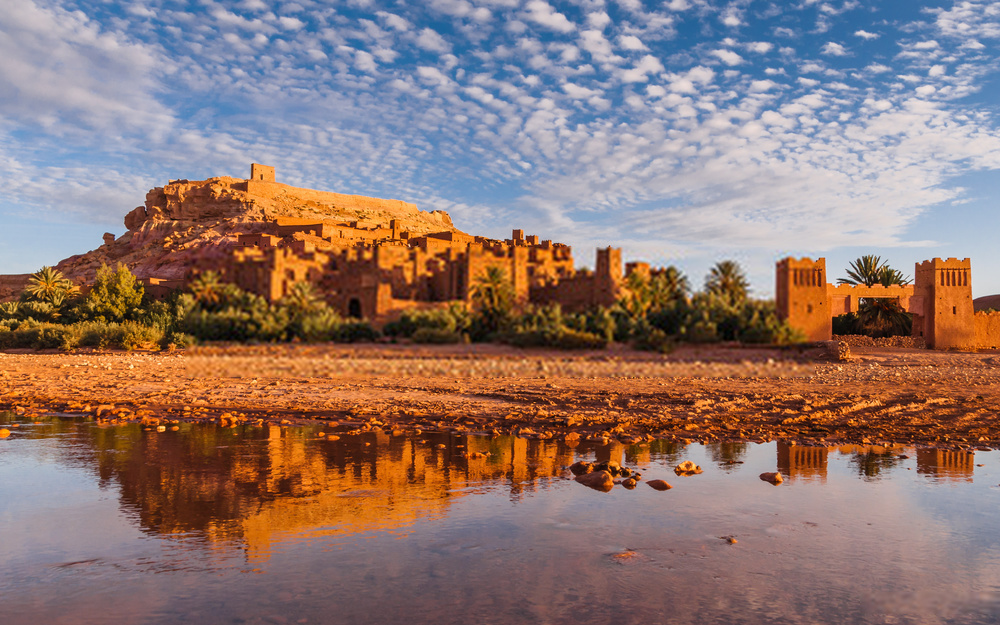
Your first cultural stop is at Aït Ben Haddou, a UNESCO World Heritage Site that feels frozen in time. This ancient mud-brick ksar has been the setting for legendary films and remains one of Morocco’s most striking examples of desert architecture. Take a walk through its narrow lanes and picture centuries of caravans passing through on their way to Timbuktu.
From there, you’ll continue to Ouarzazate, the “Gate to the Desert.” Visit its old kasbah and, if time allows, glimpse the film studios that have made this quiet town famous. The drive then takes you through the Skoura Oasis, a patchwork of palms and mud fortresses, before reaching the Dades Valley, often called the Valley of a Thousand Kasbahs. The scenery here is breathtaking — red cliffs, winding roads, and fortress-like villages perched above the river.
After a restful evening and a hearty Moroccan dinner, the journey continues toward Todra Gorge, one of Morocco’s most beautiful natural wonders. Here, you’ll meet your local guide for a gentle walk through the Todra Valley, passing through small Berber villages, lush palm groves, and workshops where traditional carpets are still made by hand. The towering canyon walls of Todra rise dramatically on either side — a perfect spot for photos and a glimpse into local mountain life.
In the afternoon, the desert draws near. As you reach the edge of Erg Chebbi, the golden dunes of Merzouga stretch before you like a sea of sand. Your camel awaits for a slow and peaceful ride toward the sunset. It’s a moment that captures the spirit of Morocco — the silence, the vastness, and the light changing across the dunes.
Your evening unfolds in a luxury desert camp, complete with comfortable tents, Berber music, and a traditional dinner under the stars. Try on Berber clothes, decorate your hands with henna, or join in the drumming around the campfire. Later, fall asleep to the stillness of the Sahara, where the only sound is the soft whisper of the wind.
Wake up early the next morning to watch the sunrise over the dunes — a sight that stays with travelers long after the journey ends. After breakfast, ride your camel or drive back across the sands to rejoin the road north.
On your return, you’ll pass through Erfoud, known for its fossils, and follow the Ziz Valley, a ribbon of green cutting through the desert. Stop in Midelt, a mountain town surrounded by cedar forests and orchards, before continuing to the cooler climate of the Middle Atlas.
A short stop in Ifrane, often called the “Little Switzerland of Morocco,” offers a pleasant surprise — tidy streets, alpine-style houses, and quiet parks. Nearby, in the Cedar Forest of Azrou, meet the friendly Barbary macaques that roam freely among the giant trees.
As the day winds down, enjoy a comfortable drive back to your hotel or riad, bringing your journey full circle. From the red city of Marrakech to the golden dunes of Merzouga and back through mountain forests, this tour captures the extraordinary variety of Morocco in just a few unforgettable days.
Audio Preview
Introduction to Sahara
Route Overview
Stops on this Tour (11)
Tizi n’Tichka Pass
As we leave the vibrant energy of Marrakech behind, you can probably feel the air getting cooler and fresher. We are beginning our climb into the High Atlas mountains, a range often referred to as the 'roof of North Africa' for its towering peaks. The road ahead is the Tizi n’Tichka, a name from the local Tamazight language that can be interpreted as the 'pass of the pastures'. Reaching an altitude of around 2,260 meters, it is the highest major mountain pass in the region. This is more than just a road, it's a gateway between two distinct Moroccan worlds.
Aït Ben Haddou Kasbah
After descending from the Tizi n’Tichka Pass, the air is warmer and the landscape has opened into the stunning Ounila Valley. Ahead of us, rising from the earth itself, you can see the Ksar of Aït Ben Haddou, its terracotta walls glowing in the afternoon sun. It appears almost like a dream, a village sculpted from sand and time. We are about to step into one of Morocco’s most iconic fortified villages, a UNESCO World Heritage site that serves as a living link to a centuries old way of life in these pre Saharan valleys.
Ouarzazate
As we arrive in Ouarzazate, you can feel a shift from the ancient silence of Aït Ben Haddou to the hum of a modern city. The name Ouarzazate is traditionally interpreted from the Amazigh language to mean 'without noise', an interesting contrast to its current role as a bustling production hub for international films. Known as the ‘Hollywood of Morocco’, this city is a fascinating blend of identities, serving as both a gateway to the vast Sahara and a portal to the world of cinematic fantasy.
Skoura Oasis
As the landscape outside Ouarzazate returns to arid plains, a ribbon of green begins to unfurl on the horizon. This is the Skoura Oasis, a vast palm grove, or 'palmeraie', that emerges from the dry earth. It's poetically known as the 'Oasis of 1000 Palms', a title that speaks to its immense scale and importance. We are now leaving the world of film sets and grand politics behind to discover a community built on the quiet, resilient rhythms of nature and the remarkable ingenuity of its people.
Dades Valley
As the green of the Skoura oasis fades in our mirrors, the landscape transforms into a world of stone and light. The earth itself blushes into shades of ochre and rose as we enter the magnificent Dades Valley. This area is a key part of a region famously nicknamed the 'Valley of a Thousand Kasbahs'. We are about to travel through a landscape where the raw power of nature and the deep history of humanity are woven together in the most spectacular fashion.
Todra Gorge & Todra Valley Walk
Leaving the wide, red vistas of Dades, we now enter a landscape that feels more intimate and infinitely more dramatic. The walls seem to close in, as if nature is drawing us into its hidden heart. Welcome to the Todra Gorge, a breathtaking limestone canyon located at the meeting point between the High Atlas and the Jbel Saghro mountains. We will leave our vehicle here to walk along the riverbed, a journey that promises a powerful shift in perspective.
Erg Chebbi Dunes – Merzouga Desert Camp
After our journey through the world of rock, you can now see it shimmering on the horizon, a golden mirage that slowly becomes real. We have arrived on the northwestern fringe of the Sahara, at the frontier village of Merzouga. Before us lies Erg Chebbi, a breathtaking sea of warm, shifting sand under a sky that seems to stretch forever. Here, the road ends, and our adventure takes a timeless turn as we meet our camel caravan and ride into the heart of the dunes.
Erfoud & Ziz Valley
Having left the sands of Merzouga behind, our journey takes us to Erfoud, a bustling desert town that serves as a gateway to the vast Tafilalt oasis. While renowned among geologists and fossil enthusiasts, Erfoud's true treasures are not immediately visible. They are buried deep beneath the stony ground, a silent testament to a time when this entire landscape was a world away from the desert we see today.
Midelt
As we steadily climb, the desert landscape gradually gives way to a greener, high-altitude plain. You can feel a distinct change in the air, it is cooler, crisper, and carries the scent of mountain earth. Welcome to Midelt, a quiet town nestled between the eastern edge of the High Atlas we traveled through earlier and the Middle Atlas mountains that lie ahead. This is our refreshing alpine pause, a moment to reset and appreciate the incredible shift in environment.
Ifrane
As we emerge from the remaining cedar forests of the Middle Atlas, the scenery changes with an almost shocking suddenness. The wild, rustic landscape gives way to manicured lawns, pristine streets, and charming chalets. Welcome to Ifrane, a town so unexpectedly European in its design that it is famously nicknamed 'Little Switzerland of Morocco'. This is perhaps the most startling contrast of our journey, a clean, green, alpine-style town that feels a world away from the desert warmth we left behind.
Cedar Forest of Azrou
Leaving the planned, alpine-style design of Ifrane behind, we now re-enter the wilder heart of the Middle Atlas. Welcome to the Cedar Forest of Azrou, a treasured part of the Ifrane National Park. The air here is cool and clean, filled with the rich, resinous scent of the trees. We're stepping out for a relaxing walk to admire some of Morocco's natural giants and to meet the forest's most famous, and certainly most lively, inhabitants.
Start this Journey
Download the Morocco Audio Tours Offline app to unlock the full audio guide, offline maps, and GPS navigation for this tour.