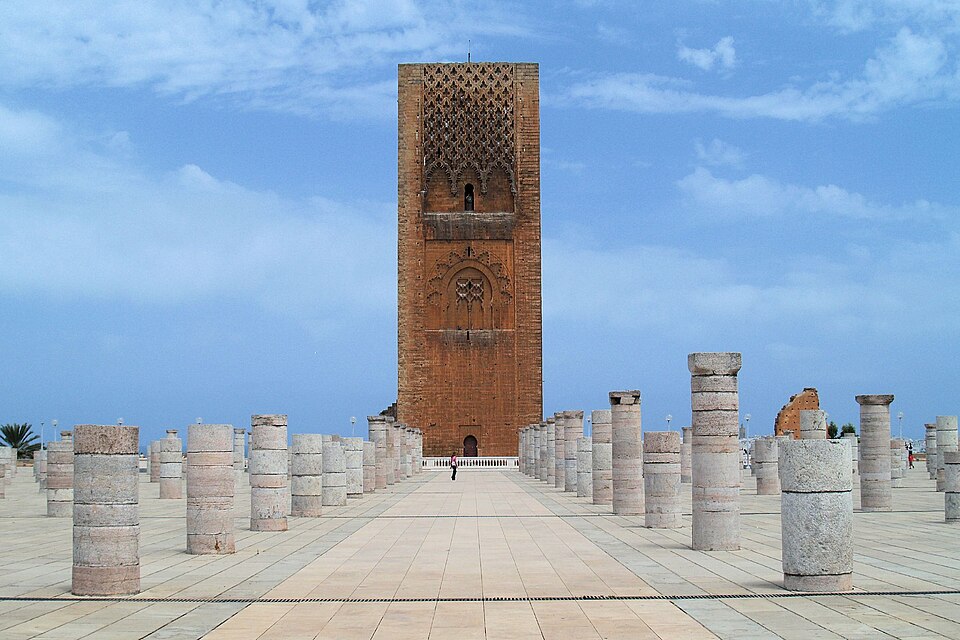
Most travelers treat Rabat as a stopover — a night between Casablanca and Fez, a brief detour to see the capital before pressing on to somewhere more famous. This tour is an argument for staying longer. Rabat is one of Morocco's four imperial cities and its least understood. It doesn't dazzle with sensory overload the way Marrakech does, and it doesn't disorient you the way Fez's medina will. What it does instead is something rarer: it rewards attention. The city is a study in interrupted ambition. The Hassan Tower was meant to be the tallest minaret in the Islamic world — its builder died in 1199 and construction stopped at half height. The Almohad capital was never completed. The Merinid necropolis at Chellah was abandoned to nature, its minarets now home to nesting storks. Even the mausoleum of Mohammed V was only built because the king died before he could plan it himself. What remains is something unexpectedly moving: a city where greatness was real, ambition was genuine, and time did what it always does. This walk visits four sites that together tell that story — from the esplanade of the Hassan Tower and its facing mausoleum, through the corsair-era medina and the Rue des Consuls, up into the blue-and-white alleys of the Kasbah of the Udayas with its Atlantic views, and finally south to the layered ruins of Chellah, where Phoenician, Roman, and medieval Morocco occupy the same earth. Calm, walkable, and almost entirely free of the hassle that defines bigger Moroccan cities. Arrive curious. Leave surprised. 4 stops · ~4–5 hours · 3–4 km walking Petit taxi recommended from the Kasbah to Chellah (~5 min, ~20 MAD). Best visited spring or autumn; morning starts recommended.
Audio Preview
Introduction to Rabat
Route Overview
Stops on this Tour (4)
Hassan Tower & Mausoleum of Mohammed V
Welcome to Rabat. And there is no better place to begin than right here, on this wide limestone esplanade where the wind comes off the Bou Regreg river and the light, especially in the morning, falls at an angle that makes everything look slightly ancient. The plateau you are standing on is called the Hassan plateau, and it has been a significant site in this city's history for over eight centuries, though its role as a living symbolic center was truly cemented in the twentieth century, when the mausoleum was built and the esplanade became a stage for state ceremonies. Ahead of you, rising from a field of broken columns, is the Hassan Tower, a minaret that never quite became what it was supposed to be. To your right, the white marble of the Mausoleum of Mohammed V catches the sun in a way that feels almost deliberate, as if the building were designed to be looked at from exactly where you are standing now. These two structures, separated by about seven hundred years of history, tell the story of Rabat better than almost anything else in the city. One is a monument to ambition that ran out of time. The other is a monument to a man who spent his life trying to give his country back to itself.
Medina & Rue des Consuls
Look at the street layout around you for a moment. Does it feel more organized, more grid-like, than you expected for a historic medina? Hold that observation, because it will matter in a few minutes. The gate you just passed through, Bab El Had, is a seventeenth-century entry point in the medina wall, its horseshoe arch worn smooth by centuries of hands and shoulders brushing past. The street ahead of you, Rue des Consuls, runs like a spine through the old city, and the moment you step onto it, the scale shifts entirely. The buildings press in closer, the light comes down in narrow bands between the upper floors, and the sounds change from open-air wind to the layered noise of a working neighborhood. This is the human story of Rabat, the one built not by sultans commissioning monuments but by families rebuilding their lives from scratch after one of the largest and most systematic forced displacements of the early modern period in the Mediterranean.
Kasbah of the Udayas
That gate you are standing in front of right now, Bab Oudaia, is not just an entrance. It is a statement. Built in the late twelfth century under the Almohad caliph Yacoub al-Mansour, it is one of the most ornate military gates in the medieval Islamic world, and yet it was almost certainly primarily ceremonial and likely never used as a functional entrance to the fortress. The arch faces a sheer drop. There is no road that ever ran through it in any practical sense. It was built to be seen, to project power, to announce a dynasty. The geometric interlace carved into the sandstone around the arch is still sharp after eight centuries, and if you run your eye along the upper register, you will notice the calligraphic band that frames the whole composition. Before we go through, take a moment. Look up at that calligraphic band. Even if you cannot read Arabic, what feeling does the precision and repetition of the pattern create for you? Coming up from Rue des Consuls, from the plaster and wood and market noise of the medina, stepping into the shadow of this gate is a genuine shift in register. The Kasbah sits on the promontory above the Bou Regreg estuary, already a fortress centuries before the medina below was built. You are now at the oldest continuously inhabited part of Rabat.
Chellah Necropolis
The taxi drops you at a gate that looks almost theatrical, a crenellated Marinid arch with carved geometric borders, flanked by two towers and framed by fig trees and wild vegetation pressing in from both sides. This is not the entrance to a museum or a tidy heritage site. It is the entrance to a place that has been accumulating history for more than two thousand years, layer by layer, civilization by civilization, each one building on top of the last without fully erasing what came before. You have just come from the Kasbah, which took you back to the seventeenth century and the Andalusian exiles who reshaped this city. Chellah goes much further. The Romans were here. Before them, the site was a Mauretanian Berber settlement, and Carthaginian traders had contact with the broader region, though the earliest substantial settlement at this specific location was the Berber city of Sala. And after Rome fell, the Marinid sultans of the thirteenth and fourteenth centuries chose this particular hillside, already ancient and already ruined, to build their royal burial complex. The fact that they built a necropolis on top of a Roman city rather than clearing it says something worth sitting with. They were not embarrassed by what was underneath. They were drawn to it.
Start this Journey
Download the Morocco Audio Tours Offline app to unlock the full audio guide, offline maps, and GPS navigation for this tour.