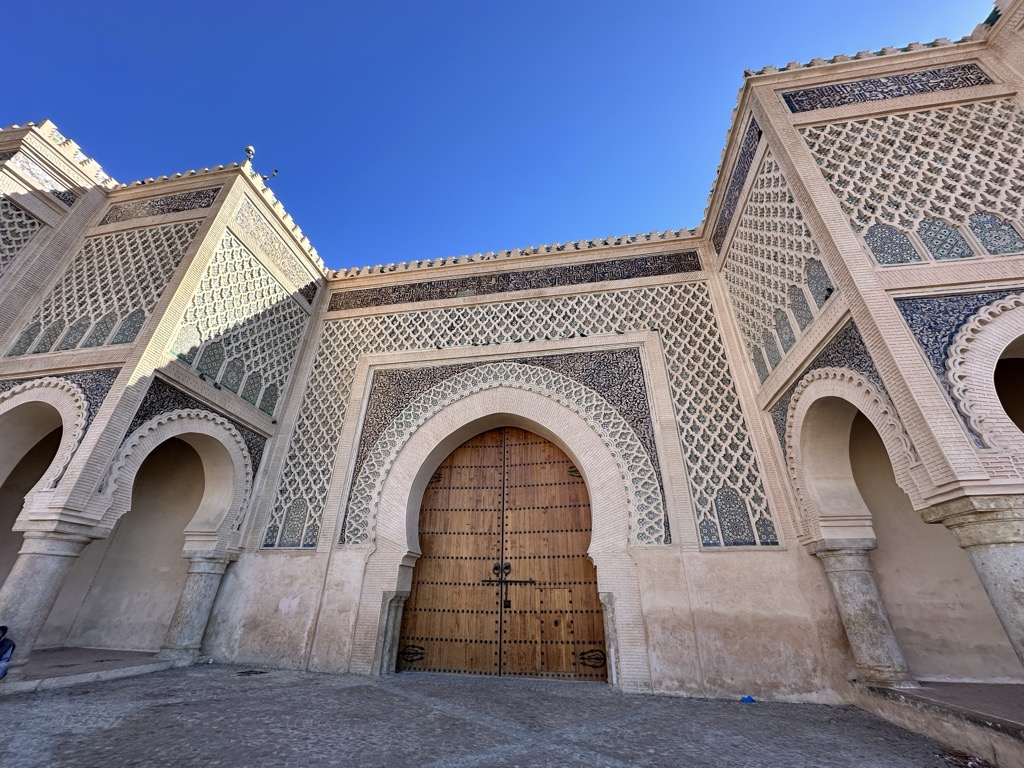
Journey back to the 17th century and discover Meknes, the imperial city built from the grand vision of one man: Sultan Moulay Ismail. This immersive audio tour guides you through monumental gates like Bab Mansour, explores the legendary Royal Stables and Granaries, and reveals the sacred tranquility of the sultan's own mausoleum. Go beyond the monumental history to uncover the vibrant life of the ancient medina and understand the legacy of the ruler who shaped this unique Moroccan capital.
Audio Preview
Introduction to Meknes
Route Overview
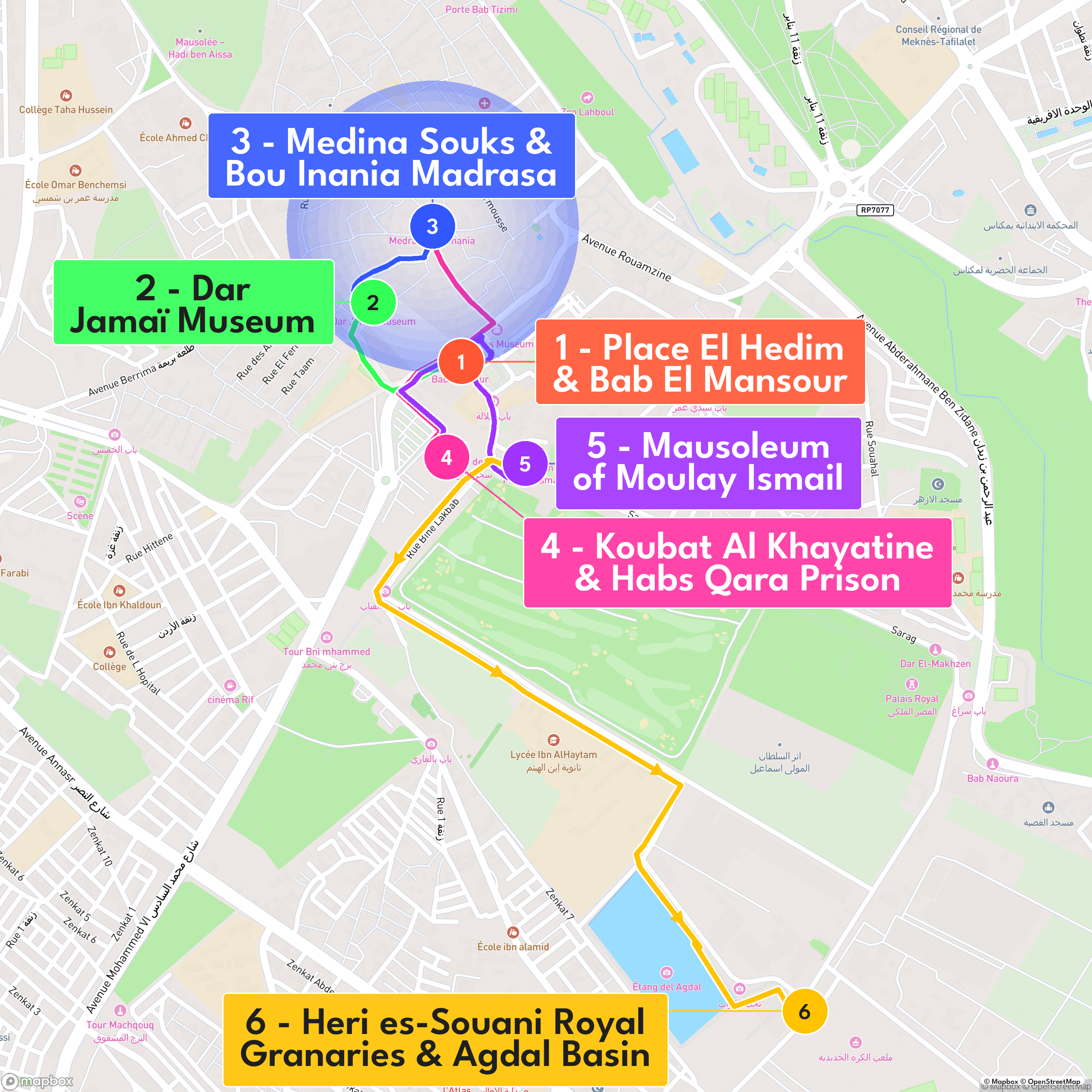
Stops on this Tour (6)
Place El Hedim & Bab El Mansour
Welcome to Place El Hedim, the big open square that feels like a front porch to Meknes, with Bab El Mansour rising at one edge like a stone stage set. Let your eyes travel across the wide paving, then up to the gate, where green zellij tiles and carved stonework catch the light differently as clouds pass. Around you, you’ll usually hear a mix of footsteps, snippets of bargaining, and the scrape of café chairs being set out. If you stand facing the gate, notice how the square gives you room to breathe, then funnels your attention straight into that monumental opening. This is a perfect place to begin because it introduces two Meknes stories at once: the everyday city that gathers in a public square, and the imperial city that announced itself through walls and gates. Take a second to feel the scale of the space—it was designed to be lived in, not just looked at.
Dar Jamaï Museum
That green tile band near the top of Bab El Mansour, the one you may have just glanced back at, was built to project power outward, to impress anyone approaching the imperial city from a distance. What you are stepping into now is almost the opposite. Dar Jamaï sits quietly at the northwest edge of Place El Hedim, its entrance tucked back from the square in a way that makes it easy to walk past without realizing what is inside. The building does not announce itself the way the gate does. There is no grand facade competing for attention, just a doorway, a courtyard beyond it, and then room after room of some of the finest domestic craftsmanship produced in Morocco during the late nineteenth century. This was not built for crowds or ceremonies. It was built for a family that had the ear of the sultan, and it shows in every detail, from the carved cedar ceilings to the zellige tilework that lines the lower walls of the central courtyard.
Medina Souks & Bou Inania Madrasa
The medina pulls you in before you have made a decision to enter it. One moment you are standing on the open stone of Place El Hedim, with Bab El Mansour behind you and the wide sky overhead, and then the alley swallows you whole. The light drops, the sounds change, and the air carries something different. Take a deep breath. What do you smell? Cumin from a spice stall, cedar sawdust from a carpenter's workshop, the faint sweetness of fresh mint stacked in crates. That is the medina welcoming you. You have just come from the Dar Jamaï Museum, where you saw what the ruling class kept behind closed doors, the silks, the painted ceilings, the instruments of refined court life. What surrounds you now is the other half of that story. These lanes were never decorative. They were, and still are, the working engine of the city, the place where Meknes has always fed itself, clothed itself, and conducted its business. Bou Inania Madrasa sits near the Grand Mosque at the medina's center, and the walk toward it is not just a route between two stops. It is the stop.
Koubat Al Khayatine & Habs Qara Prison
The medina you just left was built for living, for trading, for learning in tight human-scaled lanes. What you have stepped into now is something else entirely. Passing through that side gate beside Bab El Mansour, you crossed more than a wall. You crossed a threshold between two different ideas of what a city is for. Place Lalla Aouda opens up ahead of you, wide and unhurried, and the proportions here were calculated to produce a specific feeling in the person arriving. That feeling is smallness. Moulay Ismail, the sultan who built this entire imperial quarter in the late seventeenth and early eighteenth centuries, understood that space itself was a political instrument. The pavilion just ahead, Koubat Al Khayatine, was where he received the ambassadors of foreign powers, and the prison beneath the ground nearby held a significant portion of the coerced labor force that made all of this possible, alongside conscripted workers and enslaved people housed and working across the wider construction site. Two structures, a few steps apart, that together show you both faces of the same reign.
Mausoleum of Moulay Ismail
The previous stop left you standing in the open air of Place Lalla Aouda, thinking about confinement and power, about a sultan who could imprison thousands and build a city at the same time. Now take a few steps around the corner and you are already here. The entrance to the mausoleum of Moulay Ismail opens directly onto this same square, framed by white walls and a roof of deep green tiles that catch the light differently depending on the hour. You do not need to search for it. The green is unmistakable, and the carved wooden doors are usually standing open. This is one of the very few royal mausoleums in Morocco where non-Muslim visitors are invited inside, which is itself a statement of sorts, a deliberate openness that the site has maintained for decades. What you are about to walk into is not a museum or a monument in the conventional sense. It is an active place of devotion, visited daily by Moroccans who come to pray near the tomb of a man they consider a saint as much as a sultan. The shift from the prison you just left to this place of veneration is only about thirty meters, and that proximity is the whole point.
Heri es-Souani Royal Granaries & Agdal Basin
Those ochre walls you have been walking between are not decorative. They are functional, massive, and they were built to last centuries, which is exactly what they have done. The road from the mausoleum runs straight and long, and by the time the entrance to Heri es-Souani appears ahead of you, you have covered approximately one and a half to two kilometers of imperial infrastructure, most of it still standing at something close to its original height. That walk is itself part of the experience. You have just come from the place where Moulay Ismail was buried, the ceremonial and spiritual heart of his reign. What you are entering now is the mechanical heart, the part of his empire that kept everything else running. The granaries and the reservoir basin beside them represent a different kind of ambition than a mausoleum or a throne room. This is where the engineering logic of the seventeenth century becomes visible, and where the scale of what he was attempting starts to feel genuinely difficult to explain.
Start this Journey
Download the Morocco Audio Tours Offline app to unlock the full audio guide, offline maps, and GPS navigation for this tour.