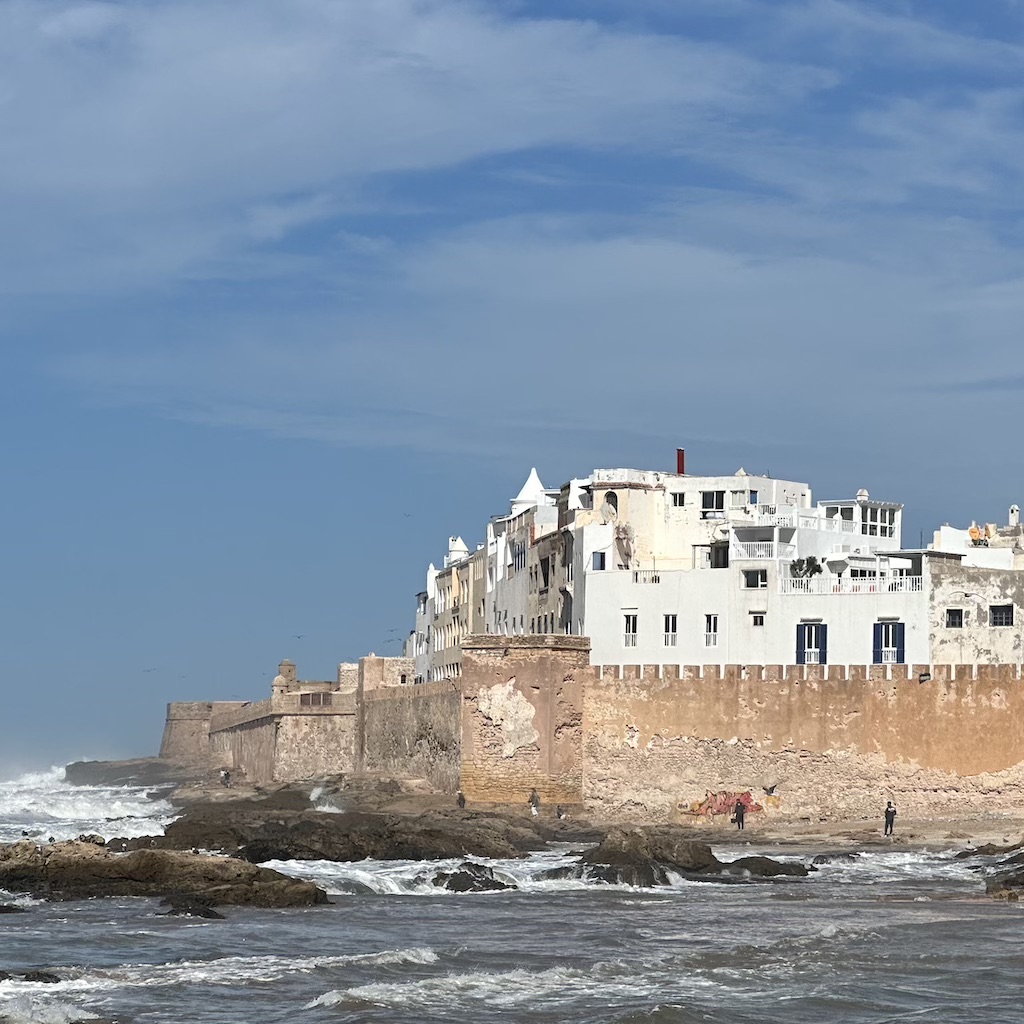
Feel the constant Atlantic breeze and hear the cry of the gulls? Welcome to Essaouira. This immersive audio tour guides you through the heart of the city's UNESCO World Heritage medina, where stories are carried on the wind.
Beginning at the historic Bab Sbaa gate, you'll journey from the formidable sea ramparts—walked by Orson Welles and the cast of Game of Thrones—to the vibrant, bustling fishing port where iconic blue boats bob in the harbor. Discover the story of the visionary Sultan who designed this city as a meeting point for cultures, explore the quiet streets of the old Jewish Mellah, and breathe in the unique scent of local Thuya woodcraft.
This isn't a lecture, it's a conversation. Guided by the warm voice of a local expert, you'll uncover the authentic Essaouira and feel the hypnotic rhythms of Gnaoua music, the true soul of the city. Press play and let the Wind City tell you its story.
Audio Preview
Introduction to Essaouira
Route Overview
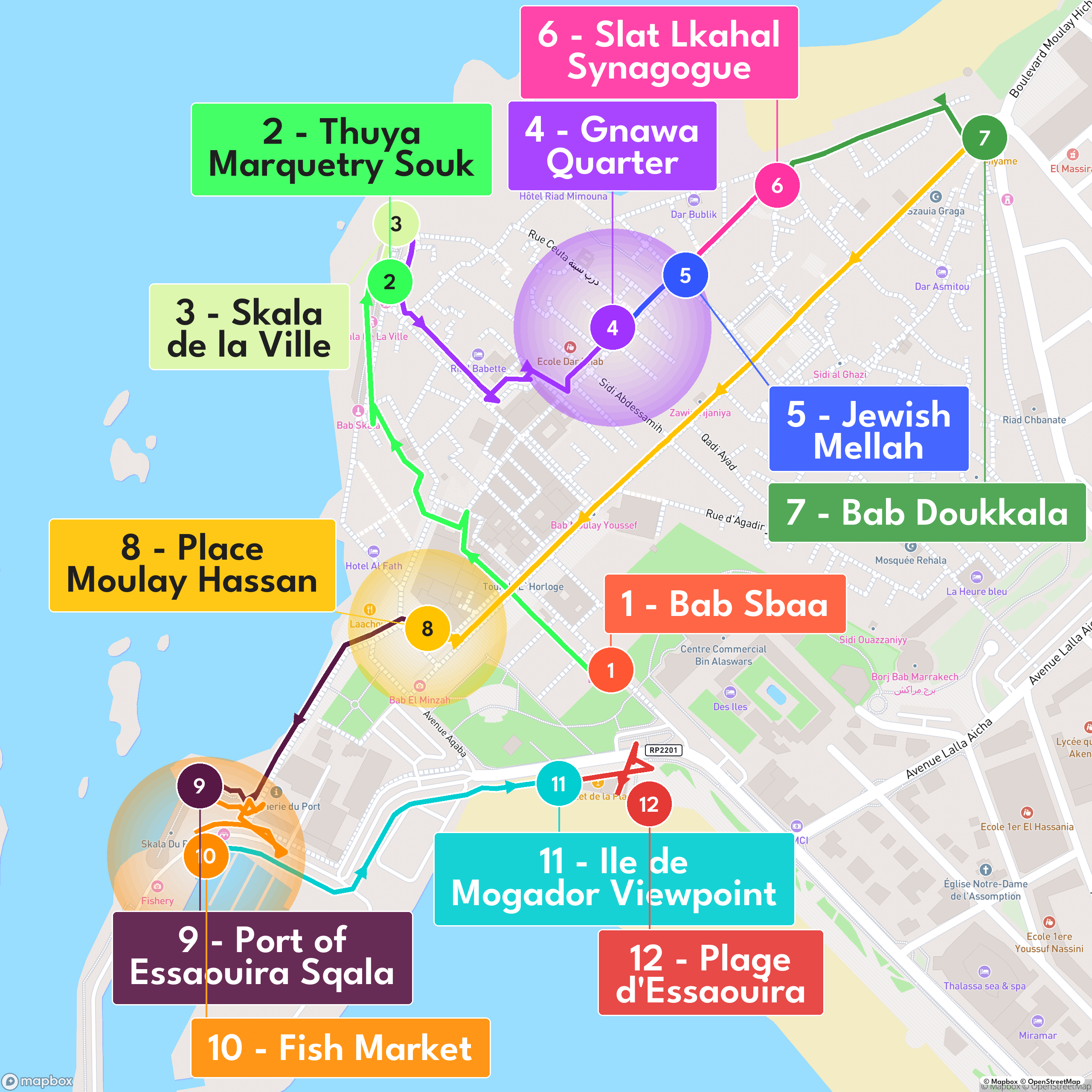
Stops on this Tour (12)
Bab Sbaa
Stand here for a moment. Don't walk through yet. The gate in front of you, Bab Sbaa, is where Essaouira begins. Not architecturally, but in a way you can feel underfoot. This city was not always here. Look at the ground beneath your feet. In 1765, it was just sand. A blank Atlantic shore, wind-scoured and empty, chosen by a sultan and handed to an architect with a single instruction: build me a city. That fact will change how you see everything you walk through today. The salt wind off the ocean, the calls from the medina just beyond that arch, the ochre walls catching the afternoon light, all of it was imagined before a single stone was laid.
Thuya Marquetry Souk
Before you even look at what is for sale here, something else will reach you first. A warm, resinous smell, somewhere between camphor and cedar and something older than both, drifts out of every open doorway in this stretch of the souk. That scent is thuya, and it is the reason you are standing here. The wood being shaped inside these workshops comes from a conifer called Tetraclinis articulata, a slow-growing tree native to the Atlas foothills east of the city, and its aroma is so persistent that a finished piece will still release it decades later if you rub the surface with your thumb. Look around you at the shelves, the tables stacked with boxes, the chessboards and picture frames in the windows. Every one of those objects began as a knotted root pulled from the ground, and every one carries the smell of that forest in it.
Skala de la Ville
These ramparts have been standing since the Portuguese first dug in here in the sixteenth century, and the bronze guns they mounted still face the Atlantic as if waiting for an enemy fleet that never came. The French military engineer Théodore Cornut redesigned the whole defensive system in the eighteenth century under Sultan Mohammed III, giving the city its elegant, almost European silhouette. Up on the Skala de la Ville, the wind comes straight off the water without anything to slow it down, and the cannons point toward the horizon with the same blank patience they have held for centuries. The place has a natural drama that no set designer could manufacture, which is why Orson Welles chose these ramparts for his Othello adaptation.
Gnawa Quarter
Close your eyes for just a second, right here, and listen. That low pulse you might be hearing right now – that's the guembri, a three-stringed lute. Let it settle into your chest before you open your eyes. If you are standing in the right part of this quarter at the right time, you may also hear the sharp, rhythmic clang of iron castanets the size of a fist. That sound is not entertainment. It is testimony. It is the sound of a community that was brought to this city in chains, survived, built something extraordinary, and has kept that thing alive for centuries. Welcome to the Gnawa Quarter of Essaouira. This is where music became medicine, and where survival became art.
Jewish Mellah
You are standing at one of the most remarkable thresholds in Morocco. Step through this gateway and the medina falls away behind you. The air in the narrow lanes here feels different — quieter, somehow more inward. This is the Mellah, the Jewish quarter of Essaouira. At its peak in the mid-twentieth century, this district held somewhere between fifteen and eighteen thousand people, and the city around it was majority Jewish. By the 1970s, almost everyone was gone. What you see now — the carved lintels, the faded ochre facades, the doorways with a rectangular notch where a mezuzah once rested — is a neighborhood holding its breath, waiting to be remembered. That remembering starts here.
Slat Lkahal Synagogue
Step inside, or pause here at the entrance, and let your eyes adjust. The light in Slat Lkahal falls differently than it does in the street outside. Up in the ceiling there is a skylight, roughly fifty square feet of glass, and the whitewashed walls below it catch the light and scatter it so evenly that the whole room seems to glow from the inside. This is not an accident. The building sits wedged between two residential walls on Rue Moise, and it was engineered from the start to pull in as much daylight as possible. What you are standing in is the principal communal synagogue of old Mogador. Not a family chapel, not a private house of prayer, but the one building that belonged to the whole Jewish community of this city, together.
Bab Doukkala
You are standing at Bab Doukkala, the northern gate of the medina, and its plainness alone is worth a moment of thought. There are no carved inscriptions above the arch, no decorative tiles, no horseshoe curve of elaborate plasterwork bidding you welcome. Just stone, mortar, and a wide rounded opening built for practicality. This was a working gate, not a ceremonial one, and the distinction matters. The road through it pointed northeast, toward the Doukkala plain and, far beyond that, to Marrakech and the caravan routes that reached all the way to the edge of the Sahara. For roughly two centuries, this opening was the city's commercial throat: grain came in, finished goods went out, and long-distance traders arrived dust-covered and heavily loaded. Before any of that, though, someone had to build the walls this gate is set into, and that story is stranger than most visitors ever learn.
Place Moulay Hassan
Step out of the medina's narrow throat and into the open air. Suddenly, the sky doubles in size. Palm trees punctuate the edges of this broad, rectangular square, and beyond the far end you can already smell the sea, carried on a wind that never really stops blowing here. This is Place Moulay Hassan. If the medina is the brain of Essaouira, this square is its lungs. It's where the tightly packed city finally exhales.
Port of Essaouira Sqala
Step through that arched gateway and let your senses adjust. The salt hits you first, sharp and briny, then the low groan of wood against rope, and then the blue. So much blue. Dozens of small fishing boats packed into the harbour basin, painted a colour that sits somewhere between cobalt and sky, all of them rocking gently on the same Atlantic swell that has been rolling in here for centuries. This is the Port of Essaouira, not the postcard version, but the working one. The version that kept this city fed, defended, and financially alive for hundreds of years. What you are standing inside right now is one of the oldest functional port enclosures on Morocco's Atlantic coast, and almost nobody talks about it the way it deserves.
Fish Market
Take a breath. Right now, you are standing at one of the most genuinely alive food spaces in all of Morocco. The smoke from the charcoal grills rolls along the port wall, mixing with salt air and the faint smell of brine. Gulls circle just overhead, and the voices around you are a mix of Darija, Tachelhit, French, and whatever language you happen to speak. Nobody here is performing for the tourists. This is where Essaouira eats, and you are invited.
Île de Mogador Viewpoint
Face the water, and just stay with it for a moment. That strip of pale rock sitting low on the horizon, barely a kilometer and a half from where you're standing, is the Île de Mogador. It looks quiet. Unhurried. A flat smudge of stone with a mosque tower and some old walls just visible through the Atlantic haze. The wind off the water carries nothing from that island. No sound, no smell. And that silence is itself deceptive, because the island holds more layers of human history than almost anywhere else on this coast. It was occupied before the city you're standing in even existed. Before the medina walls, before the port, before the cannons. The island came first, and everything you see behind you grew, slowly, in its shadow.
Plage d'Essaouira
Step out onto the sand and feel it immediately. Not warmth, not stillness, but force. The wind hits you square in the chest the moment you leave the city behind, and it does not apologize. This is the alizée, or taros in the old Amazigh tongue, the trade wind that has been defining this coastline for longer than the city itself has existed. Look south. The beach opens in front of you for roughly ten kilometres, flat, hard-packed, pale as bleached bone, and it ends not in a road or a town but in living dunes. Look back over your shoulder at the medina walls, white against the sky. This is the view that closes the tour. The city was built to face outward, and you are standing at the edge it was always facing.
Start this Journey
Download the Morocco Audio Tours Offline app to unlock the full audio guide, offline maps, and GPS navigation for this tour.